
The disclaimer he didn't notice
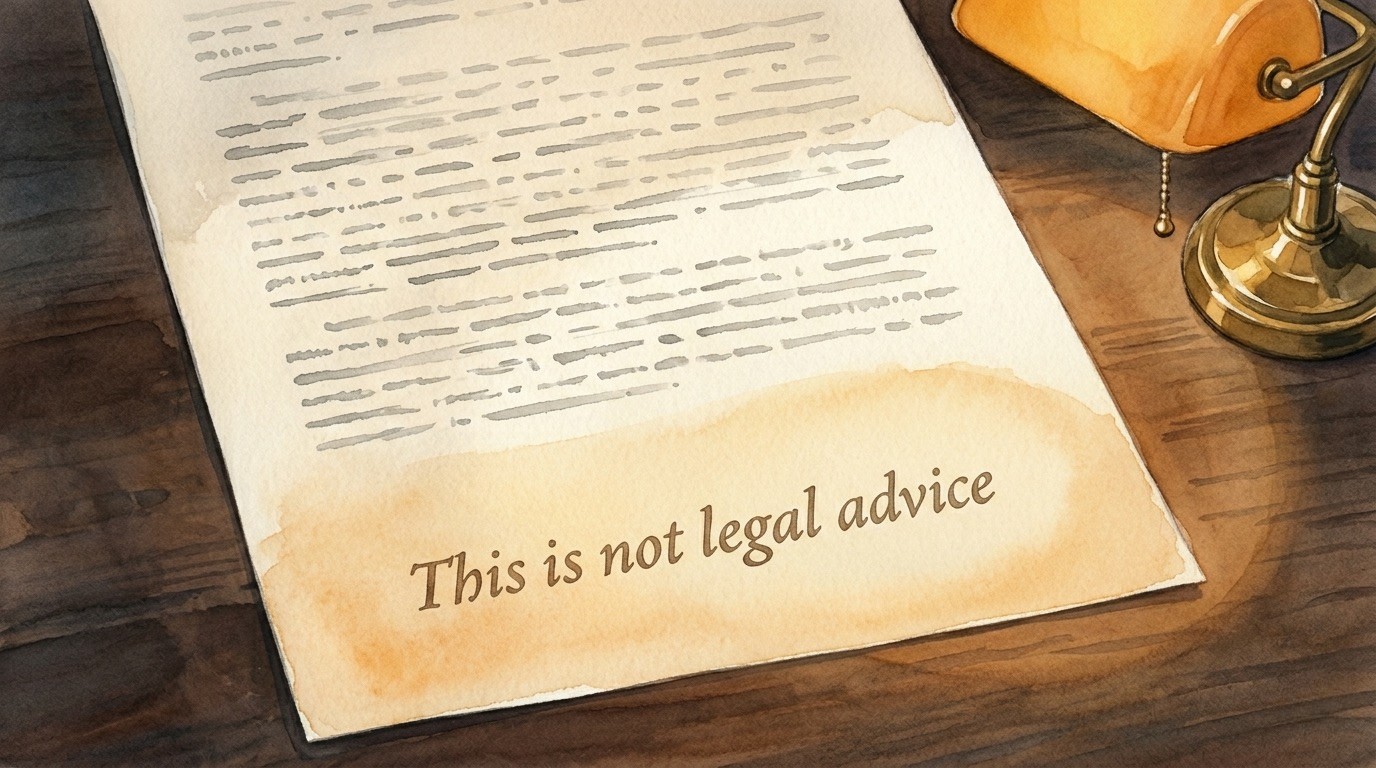
This is not a substitute for professional advice. Please consult a qualified expert for matters specific to your situation.
A sentence just like that sat at the bottom of the document my international advisor sent me last month. He had not noticed it.
I noticed it because I was reading carefully. The matter was complex. An international agreement on which several of the substantive points fell outside my own expertise. I had brought him in for exactly that reason, on a wide deadline, because both of us knew the input would take real work.
What came back came back in hours.
The setup
The shape of the engagement was unremarkable. Client matter, international counterparty, the kind of agreement that spans more than one jurisdiction. The parts I could handle, I handled. The parts I could not, I sent across to an advisor qualified for those parts, with the working draft, the open issues, and the specific questions where I needed his read.
I gave him room. A full week, with an open invitation to jump on a call if he wanted to talk anything through. The matter was complex enough that I expected him to push back on the deadline if anything. I wanted his answer to be slow and right, not fast and approximate.
A few hours later, his response landed in my inbox.
The structure was tidy. A full table with colour-coded references. Story-like paragraphs. Issues outside his scope, flagged neatly. And, more telling, some issues inside his scope, not flagged at all.
At the bottom of the file, in italicised text he had not deleted, was the disclaimer the model had appended to its output.
The teardown
I read it twice before I replied. I wanted to be sure of what I was looking at.
The cadence first. The specific first... second... finally rhythm that AI writing falls into when it has been asked to summarise something complex. Em dashes where they did not belong. Sentences that sound right and say nothing. I have used AI in my own work often enough this past year to know what the seams look like when the human in the loop has not smoothed them.
Then the disclaimer at the bottom. This is not a substitute for professional advice. Sitting in the body of his deliverable, in the same italics the model had used.
I responded by email. We went back and forth a few times. His position, by the end of the exchange: the input was still his. He had reviewed it. AI had drafted the structure. The substance was him.
I asked him to confirm, in writing, that the document represented his final professional advice on the matter as instructed.
That took several attempts. He confirmed it eventually.
The engagement moved on. We were past the point where swapping advisors would not damage the client's timeline, so I worked with what I had. That is the position you are sometimes in.
A few weeks later, three follow-up questions came up. Same case, same client, but a different topic. A new instruction to him. Simple questions, the kind that in a working relationship get answered in two sentences or on a quick call.
He sent back five pages.
Five pages of memo in answer to two questions. A management summary at the top. An introduction. Next steps with a rollout timeline. A schedule of when to ask which questions. All of it AI-centric. Literally copy-pasted into the body of an email. He had removed the AI disclaimer this time, but it was still very clear where the text had come from.
What surprised me
The disclaimer was not the worst part. The disclaimer was the obvious tell. The reason I am writing this is what came after.
The reluctance to confirm in writing that the document was his final advice. That was the tell that mattered. It is one thing to use AI to draft. Most of the profession does this, increasingly, and there is nothing inherently wrong with it. It is another thing to refuse, when asked, to put your name behind the output as work you stand by.
The five-page memo that came back when two paragraphs would have done. That was the second tell. AI made length cheap. When the advisor you have engaged for judgment sends you volume where they used to send you a call, something about their relationship to their own work has shifted.
The honest limitations
I want to be precise about what this case proves and does not prove.
It does not prove that this advisor was bad. I am sure he is qualified, given his position. The engagement closed. It does not prove that AI in advisory work is dangerous. I use AI in my own work every week.
What it proves is something narrower. This particular case contained a signal I could spot, and I spotted it. The disclaimer was literally in the body of the output. I would have caught it six months ago. Anyone reading carefully would have caught it.
The harder cases are the ones where the signals are not this obvious. Where the advisor read the AI output before sending. Where the disclaimer was deleted. Where the cadence was smoothed. There are professionals out there doing this who will not let you know. You cannot always spot it. But be sure to try.
AI in advisory work is not the issue here. The issue is when one party's quick turnaround becomes the other party's slow one. AI saved him hours. It cost me hours. The work did not disappear. It moved.
What to look for
Three tells, ranked by how informative each one is.
The first is the AI's own disclaimer surviving into the deliverable. It tells you the advisor did not read what they sent. This case had it. Most cases will not.
The second is reluctance to confirm in writing that the output represents the advisor's final professional view. This is the more serious signal. If a professional will not stand behind the deliverable as theirs, the deliverable is not advice. It is a draft they are passing through.
The third is volume where you asked for an answer. AI made it free to produce more. Brevity is now the luxury, and the evidence of real engagement. If your advisor cannot fit the answer to a follow-up question in a paragraph or offer to discuss it on a call, the engagement is drifting.
I am running an extra sanity check on every external deliverable now. Not because I expect to catch every case. Because I expect not to. The check is what I owe my clients regardless of whether it works that day.
Close
The disclaimer at the bottom of that file should not have been there. It told me the advisor had outsourced the typing without doing the reading.
What I keep coming back to is this. The obvious version, the one I caught, is probably not the one to worry about.