
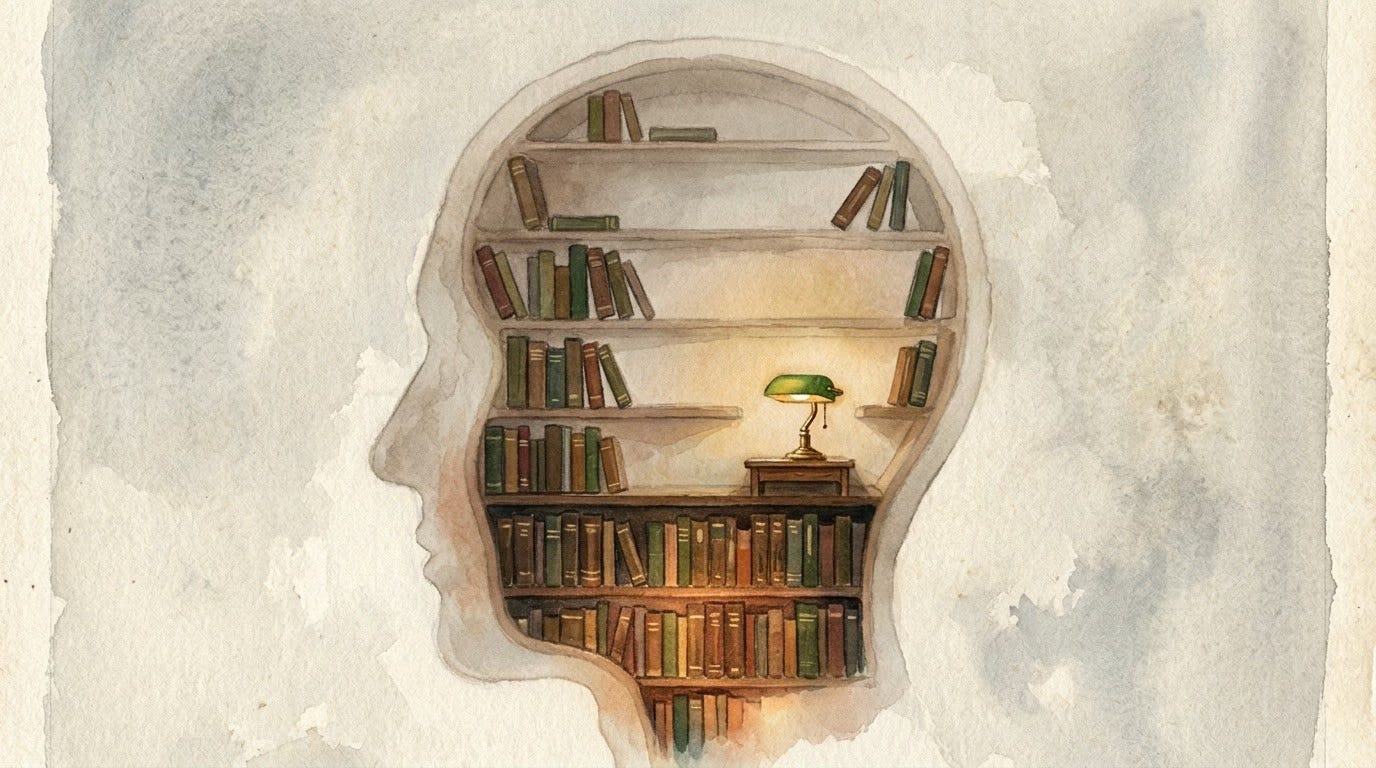
The shelf in my head was emptier than I expected
I have been noticing something become more prevalent over the last few weeks, perhaps months, of working with Claude. My productivity is up, my memos contain more verified sources, and the quality of the work seems to have gone up with it. Something else has been happening alongside the progress, and the easiest way to describe it is that the work is starting to turn into a blur. Recalling specific sentences of a contract I drafted, or a case I researched for a memo, used to come with the territory. Ever since I have been using LLMs more frequently in my work, I have noticed I need to dig more.
I noticed it most clearly two Monday mornings ago, preparing for the week ahead. I sat down with a contract I had drafted three weeks earlier, knew there was a particular clause I wanted to revisit, and found myself searching the file for it rather than knowing roughly where it sat. Six months ago I would have known.
The setup
The fight for your attention is well-trodden territory. Minutes of eyeball time drive advertising value, advertising value drives platform behaviour, and a whole industry has grown up around the mechanism: TikTok dances and AI slop on one side, app blockers and screen-time tools on the other. The mechanics behind this are very well described in Anna Lembke's Dopamine Nation. The book named the underlying mechanism cleanly enough that it ended up on most of our shelves. Over simplifying the advice that comes out of all this work is to make your bed first thing, block your apps before ten, and earn the dopamine reward instead of taking the cheap one.
Doing all of this would make sure you could withstand the fight for your dopamine, just a little better and maybe stay productive. However, the latest challenger for your dopamine comes for what used to be that last piece of sacred land. It does not interrupt you, it does not buzz, and it does not need a notification because you are already looking at it. More and more it lives inside your laptop, inside the files you bill for, inside the work you opened deliberately because you wanted to make progress, and the deliberate part of that opening is what makes it harder to recognise as a threat.
The teardown
A study from MIT last year landed a line that defines it properly:
AI tools, while valuable for supporting performance, may unintentionally hinder deep cognitive processing, retention, and authentic engagement with written material. If users rely heavily on AI tools, they may achieve superficial fluency but fail to internalize the knowledge or feel a sense of ownership over it.
The researchers call the resulting state cognitive debt, and reading their finding with the word dopamine held in mind shows a lot of similarities.
The dopamine system in your brain is, among other things, the way it pays you for closing a cognitive loop, whether that loop is solving a problem, rewriting a sentence until it finally says what you wanted, or simply making your bed. The payout is the signal that tags the work as worth remembering, which is why you can recall a matter you argued at eleven at night three years ago and not the seventeen status updates you received last week. The remembering is the dopamine doing its job after the fact, on the work that earned it. (I am offering an oversimplified read of this. I have no training in the field, and the actual picture is more complex than the version I can describe.)
If this is a dopamine story, here is what I think is happening. When you prompt a model, the response lands at your desk in twelve seconds and the completion hit arrives with it, which means your brain has received the reward it normally holds in reserve for when you have solved the problem. Now the reward arrives before the work has happened, and once that is true, the work no longer needs to happen for the brain to feel done, because the system that would have asked for it to be completed has already been paid. Cognitive debt is the name researchers give the state this bypass leaves you in, and the loss of ownership is the first symptom you tend to notice. Ownership is the felt sense of having done the work. If the work has not been done, how could you still feel that it is yours?
Gianmarco Disario put the symptom plainly in his Substack:
By using LLMs instead of writing a text yourself, you massively decrease the amount of ownership you feel over the written text. This is understandable, but it decreases your retention of the written text. You can barely cite anything from the text and even find it hard to remember the core thesis of the text.
The power of the tools available to us is not up for debate here. What we should notice is that this is yet another application pulling at the strings of our dopamine, and probably at plenty of other hormones besides. Where this one differs is that it is not after our spare time. It is hijacking our most productive hours, and it might be gaslighting us into believing we are more productive and more successful, while in fact we are seeing more and more bloated memoranda full of well-intentioned rhetoric land on our desks.
What surprised me
The piece you are reading was meant to be the test case for the argument it is making, which means I wrote the first draft myself, sent it to Claude expecting a polish, and watched it come back longer and tidier and somehow less mine in a way I could feel before I could point at it. I went back to my draft and kept going from there. What surprised me is how strong the pull remains even when you understand the mechanism producing it. Two months of LLM-assisted drafting makes typing the thing yourself feel intolerable, even though it is only your tolerance that has changed. However, starting over and spending my weekend writing this piece myself did end up producing a more valuable dopamine hit, as it correlates to the amount of effort spent to get there.
The honest limitations
I am not arguing against using AI in your work, and I would be doing you a disservice if the piece read as if I were. I use it most days, and the issue you are reading was drafted with Claude open in a second window as a sparring partner. I am also not arguing that one study and one framing closes the question, and the mechanism I sketched above is my read on what they observed rather than a settled finding. I would not stake a client matter on it, although I am staking a personal habit on it, which is a lower bar. That being said, I do think there is a real cost, it is paid in retention and ownership, and most of us are not yet pricing it into the workflows we are adopting, and all of this might lead to similar dependencies to those we are already seeing in social media.
What I now try to do
What I now try to do is essentially the social media app blocker of my use of Claude, so that I do not feel productive without actually having any ownership of my work.
I first try to decide which pieces of work I genuinely need to own, because not every piece is one worth remembering. Status updates, summaries, the third draft of an engagement letter, those are good examples of work a model can carry the heavier load on. The requirement for recall is low, the writing can be referenced later if that changes, and the time saved is real. The matters that will run as longer projects, a contract negotiation that will sit on the desk for months, the meeting preparation where you will need to think on your feet, those AI can only assist on. For those, you do the heavy lifting yourself. You write the first outline, the steps, the risks you spot, and the thinking that will make the piece yours, and that is what you stress-test with the LLM afterwards. You can let the model challenge your thinking, but you bear the cognitive load. The process is slower, and the value grows quickly.
This is the part that is the worst, because Claude can now draft an entire agreement that is a better first draft than most juniors can produce. You still need to do this part yourself, or, if you prefer, draft it in parallel with the screens closed and compare the two versions only once both exist. This form of human-in-the-loop accountability is fading across the board. However, if you want to understand and improve your own work, I do not see another way of staying involved.
Close
The clause I went looking for two Monday mornings ago was still in the contract, exactly where I had put it. The work that should have left me knowing where it sat, though, had not quite been done. The dopamine for the drafting had been collected on a Tuesday afternoon, in a chat window, in twelve seconds. By the time the recall was supposed to form, the reward was already in. The deliverable was sound. The shelf in my head was emptier than I expected.